From Landfill to Factory Floor: Uganda's Circular Economy Pioneers Are Quietly Solving America's Recycling Crisis
America has a recycling problem. Despite decades of public awareness campaigns, curbside bin programs, and corporate sustainability pledges, the United States still sends the vast majority of its recyclable materials to landfills or incinerators. The collapse of China's National Sword policy in 2018, which effectively shut the door on American plastic exports, exposed just how fragile the country's recycling infrastructure truly was. Today, many municipalities have quietly abandoned recycling programs altogether, unable to find viable end markets for collected materials.
The solution, it turns out, may not originate in a California tech incubator or a European green policy framework. It may be taking shape in Kampala.
Building Circular Systems in the Heart of East Africa
Uganda's waste-to-value sector has developed not out of idealism, but out of necessity. With limited municipal waste infrastructure and rapidly urbanizing cities generating increasing volumes of plastic, electronic waste, and industrial byproducts, Ugandan entrepreneurs faced a stark choice: treat waste as a liability or engineer it into an asset.
Many chose the latter. Across Kampala, Jinja, and Mbarara, a new generation of manufacturers has built processing facilities that convert post-consumer plastic into construction materials, furniture components, and packaging intermediaries. Others have established formal e-waste collection networks, extracting recoverable metals from discarded phones, computers, and household appliances before channeling refined materials into regional electronics supply chains. Still others have turned agricultural residue—husks, stalks, and pulp that would otherwise be burned—into composite building boards and biofuel pellets.
What distinguishes Uganda's approach from earlier, donor-driven recycling experiments on the continent is its commercial architecture. These are not charity projects. They are margin-driven businesses with defined input costs, processing efficiencies, and buyer relationships. That distinction matters enormously to the American companies now paying attention.
The Supply Chain Americans Have Been Asking For
For US corporations navigating the intersection of regulatory pressure and consumer expectation, the appeal of Uganda's circular economy model is straightforward: it offers verified, traceable, recycled feedstock at a scale and price point that domestic alternatives currently cannot match.
Consider the plastics segment alone. American manufacturers in packaging, construction, and consumer goods have committed publicly to incorporating recycled content into their products. Many have set targets of 30, 50, even 100 percent recycled plastic by 2030. Yet the domestic supply of food-grade and industrial-grade recycled resin remains chronically insufficient. Prices are volatile. Quality is inconsistent. And the infrastructure to sort, clean, and process post-consumer material at industrial volumes simply does not exist in most American cities.
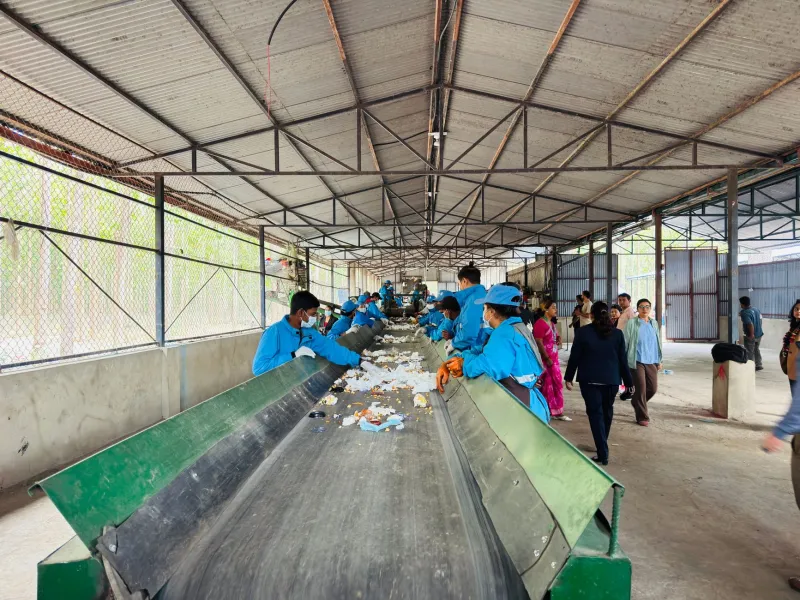
Ugandan processors, by contrast, have built vertically integrated operations that control material collection, sorting, cleaning, and pelletizing under a single roof. Several facilities in the Kampala Industrial and Business Park have attracted investment from East African development finance institutions precisely because their business models close the loop in ways that Western recyclers have struggled to replicate. The resulting pelletized output—meeting international standards for moisture content, contamination levels, and material consistency—is increasingly exportable.
A handful of American importers have already begun sourcing recycled plastic resin from East African suppliers, drawn by cost advantages and the ability to verify chain-of-custody documentation that satisfies both internal ESG auditors and third-party certifiers. Uganda's entrepreneurs are not waiting to be discovered. They are actively building the certifications, logistics relationships, and commercial frameworks necessary to compete in global markets.
Electronics and the Second-Life Economy
The e-waste dimension of Uganda's circular economy carries its own distinct opportunity. The United States generates more electronic waste per capita than almost any other nation, and a significant portion of that material ends up in informal processing operations abroad—often in conditions that are environmentally and ethically indefensible. That reputational risk has become a genuine liability for American technology companies and retailers.
In Uganda, a different model is emerging. Formal e-waste processors operating under environmental permits and international standards agreements are building the infrastructure to receive, document, and responsibly process end-of-life electronics. Some have partnered with global certification bodies to offer auditable destruction and material recovery services. Others are developing refurbishment pipelines that extend product life cycles before materials enter the recovery stream.
For American technology companies managing product take-back obligations under extended producer responsibility legislation—a regulatory regime that is expanding rapidly across US states—these certified East African partners represent a credible, cost-effective option. The logistics chain is longer than a domestic solution, but the combination of lower processing costs, verifiable compliance documentation, and genuine environmental integrity is proving attractive to procurement teams under pressure to demonstrate responsible end-of-life management.
The Investment Calculus
American investors with exposure to impact, ESG, or frontier market strategies are beginning to map Uganda's circular economy sector with fresh attention. The investment thesis is layered. At the macro level, the global market for recycled materials is projected to exceed $600 billion by the end of the decade, driven by regulatory mandates in the European Union, accelerating corporate commitments in North America, and the structural shift away from virgin resource extraction. Uganda's entrepreneurs are positioning themselves to capture a share of that expanding market from the supply side.
At the micro level, the businesses themselves are often capital-efficient by the standards of American industrial ventures. Many have reached operational viability on relatively modest initial investment, constrained not by demand but by working capital and equipment financing. For development finance institutions, family offices, and impact funds looking to deploy capital with measurable environmental returns, Uganda's waste processors represent a category that is both undercapitalized and commercially credible.
The risk profile is real. Currency exposure, infrastructure gaps, and the logistical complexity of moving processed materials to Western end markets all require careful structuring. But the fundamental economics—converting a waste stream into a product with genuine buyer demand—are sound in a way that many higher-profile green technology ventures are not.
What Uganda's Model Teaches American Industry
Perhaps the most instructive dimension of Uganda's circular economy story is not the specific products being made, but the systemic thinking that underlies the enterprise. Ugandan entrepreneurs did not have the luxury of designing recycling infrastructure as a peripheral add-on to an existing industrial base. They had to build closed-loop systems from the ground up, integrating collection, processing, and distribution as a unified commercial operation.
That constraint produced a discipline that American recycling infrastructure has historically lacked. In the United States, the recycling value chain has long been fragmented among municipal collectors, private sorters, commodity brokers, and end manufacturers—each optimizing for their own economics with limited coordination. The result is a system that functions adequately when commodity prices are high and collapses when they are not.
Uganda's integrated model offers a different blueprint. It is one that a growing number of American corporations—particularly those building private recycling supply chains to meet their own material commitments—are studying with genuine interest.
The eagle, Uganda's national symbol and the emblem of this publication, is defined by its capacity to see clearly across vast distances. What Uganda's circular economy entrepreneurs have seen—and built toward—is a future in which waste is not a problem to be managed but a resource to be mobilized. American industry is only beginning to catch up to that vision.